
(Venice, Italy) Venice, the most romantic city in the world, has a dirty little not-so-secret: it is covered with graffiti, most of which is "tags." On Sunday, October 21, 2012, a group of concerned citizens in Venice participated in an anti-graffiti Cleaning Day, organized by Milan, joining cities throughout Italy in a national effort to clean up the country on the outside. At the same time, the Italian government fights to clean up the corruption on the inside with an anti-graft bill.
From Reuters, Italy Moves Closer to Passing Anti-Corruption Law:
 To accelerate passage of the draft law, which
has languished in parliament for two years, Prime Minister Mario Monti
called a confidence vote, which curtails debate and ends voting on
individual amendments.
To accelerate passage of the draft law, which
has languished in parliament for two years, Prime Minister Mario Monti
called a confidence vote, which curtails debate and ends voting on
individual amendments.
... "A serious law against corruption is a fundamental factor for Italian activities and international investment in order to unblock the country's growth," Monti told local government representatives at a conference in Bologna as voting took place.
Monti's unelected government is pushing hard to get the law passed quickly to shore up confidence in the political system and show that something is being done to stem graft.
In an economy of about 1.7 trillion euros, corruption siphons off 60 billion euros (48.7 billion pounds) a year out of the public coffers, according to the country's audit court, a body of magistrates which overlooks public finances.
Stories of extravagant corruption as Italians suffer in a deep recession have become a mainstay of the media.
For example, they have been reporting prosecutors' allegations that an official in the regional government of Lazio, which includes Rome, siphoned off millions of euros of public campaign financing to holiday in the French Riviera, dine on oysters and champagne at exclusive restaurants, and buy a BMW 4x4 when it snowed in the city.
As the Italian government struggles to pass its anti-graft law, Italian citizens are fighting back, too, with an anti-graffiti effort. The Facebook group "I nostri masegni puliti e splendenti" or "Our Stones Clean and Bright" met in Campo San Leonardo to clean up a wall of graffiti. Masegni are stones that Venetians have been using for centuries for pavement and construction. From Venipedia:
Masegni stones are the most prevalent paving stone in Venice, in fact they make up over 70% of all Venetian pavement. There are two types of masegni stones used in paving Streets. Traditional masegni have been used since 1676 and hold great historical value to the city. Newer masegni stones are used in some Street Pavement and are used to replace unusable traditional stones. Both stones are made from quarried Trachyte from the Euganean Hills.
When we arrived, we were handed an outfit that resembled a gauzy spacesuit to protect our clothing, a paint brush and a bucket of paint. Some of the group were professionals, but others, such as myself, were novices, including some children. The atmosphere was festive and light, and soon attracted a crowd that observed our efforts. Care was taken to prepare the area so that we didn't splatter the pavement with our good intentions. Reporters came by; we were on the local news, and even made the front page of the local paper, la Nuova Venezia, today.


After the wall (and the Telecom phone booth in front of it), was cleaned, the workers celebrated with prosecco and snacks sent over by local businesses. Everyone agreed the wall would look even better after the paint dried.
While we were painting the wall in the historic center, over on the Lido another group polished up the Teatro Marinoni located inside the old hospital complex, getting ready for the new season. The Marinoni Theater was bequeathed to the residents of Venice by Mario Marinoni, and has been part of yet another ongoing struggle between the Venetians and private development, who want to turn the former hospital into a luxury complex. To me, there is no reason for one project to negate another. There is plenty of room for all.
Also, yesterday, was the FAI marathon, part of another national effort to rediscover treasures right in front of our eyes. If you missed it, you can find the Venetian Cat - Venice Blog post at The Wells of Venice - FAI Marathon.
As the world struggles to find its balance between creation and destruction, honesty and corruption, if we all just make some small efforts, the dark forces will be balanced by the light.
Ciao from Venezia,
Cat
Venetian Cat - The Venice Blog

... "A serious law against corruption is a fundamental factor for Italian activities and international investment in order to unblock the country's growth," Monti told local government representatives at a conference in Bologna as voting took place.
Monti's unelected government is pushing hard to get the law passed quickly to shore up confidence in the political system and show that something is being done to stem graft.
In an economy of about 1.7 trillion euros, corruption siphons off 60 billion euros (48.7 billion pounds) a year out of the public coffers, according to the country's audit court, a body of magistrates which overlooks public finances.
Stories of extravagant corruption as Italians suffer in a deep recession have become a mainstay of the media.
For example, they have been reporting prosecutors' allegations that an official in the regional government of Lazio, which includes Rome, siphoned off millions of euros of public campaign financing to holiday in the French Riviera, dine on oysters and champagne at exclusive restaurants, and buy a BMW 4x4 when it snowed in the city.
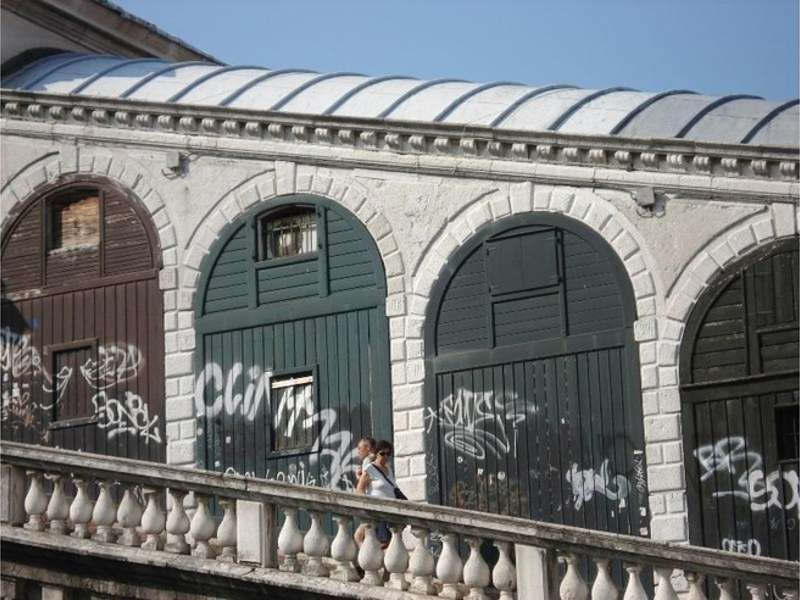 |
| Graffiti on Rialto Bridge |
Masegni stones are the most prevalent paving stone in Venice, in fact they make up over 70% of all Venetian pavement. There are two types of masegni stones used in paving Streets. Traditional masegni have been used since 1676 and hold great historical value to the city. Newer masegni stones are used in some Street Pavement and are used to replace unusable traditional stones. Both stones are made from quarried Trachyte from the Euganean Hills.
 |
| The wall before the cleaning |


After the wall (and the Telecom phone booth in front of it), was cleaned, the workers celebrated with prosecco and snacks sent over by local businesses. Everyone agreed the wall would look even better after the paint dried.
 |
| Photo: Venice Human Archipelago |
Also, yesterday, was the FAI marathon, part of another national effort to rediscover treasures right in front of our eyes. If you missed it, you can find the Venetian Cat - Venice Blog post at The Wells of Venice - FAI Marathon.
As the world struggles to find its balance between creation and destruction, honesty and corruption, if we all just make some small efforts, the dark forces will be balanced by the light.
 |
| The Wall - Before and After |
Cat
Venetian Cat - The Venice Blog

Venice, the most romantic city in the world, has a dirty little not-so-secret: it is covered with graffiti, most of which are "tags." On Sunday, October 21, 2012, a group of concerned citizens in Venice participated in an anti-graffiti Cleaning Day, organized by Milan, joining cities throughout Italy in a national effort to clean up the country on the outside.
ReplyDeleteThey did an awesome job and I would love to thank them.
ReplyDelete